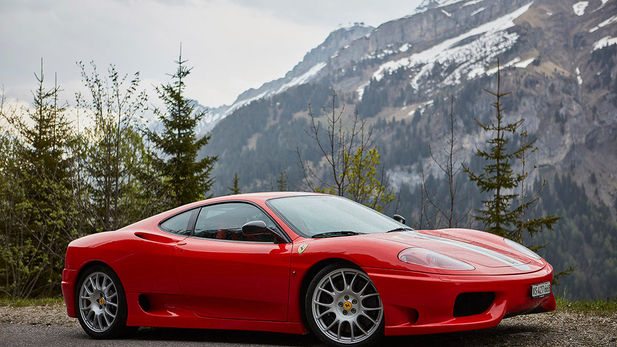
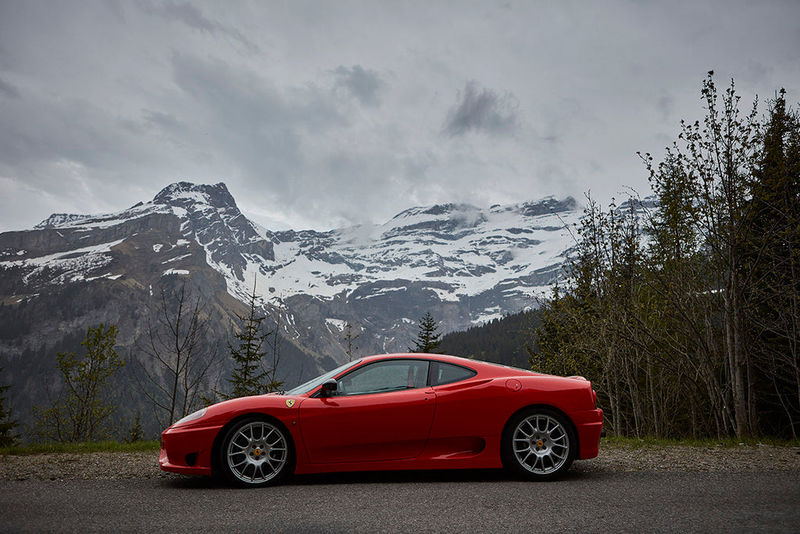
Track-day specials are a staple of Ferrari’s model line-up, but that wasn’t always the case. We drive the lightweight 360 Challenge Stradale “road racer” in the Swiss Alps.
While hardcore track-day specials regularly appear in the Prancing Horse’s line-up, that hasn’t always been the case. You could argue that the 1st such car was the Ferrari F355 Challenge, as some early examples were street-legal, but the lineage properly begins with this car: the 360 Challenge Stradale.
In 1999, Ferrari introduced the revolutionary 360 Modena, named after the town in which Enzo Ferrari was born. The 360 represented a significant step up from its predecessor, the F355, in performance, aerodynamics, and technology. Fans of the Ferrari 360 Modena (of which there are many) got an even bigger treat in 2003, when Maranello created a new version in the mould of the 360 Challenge race car.
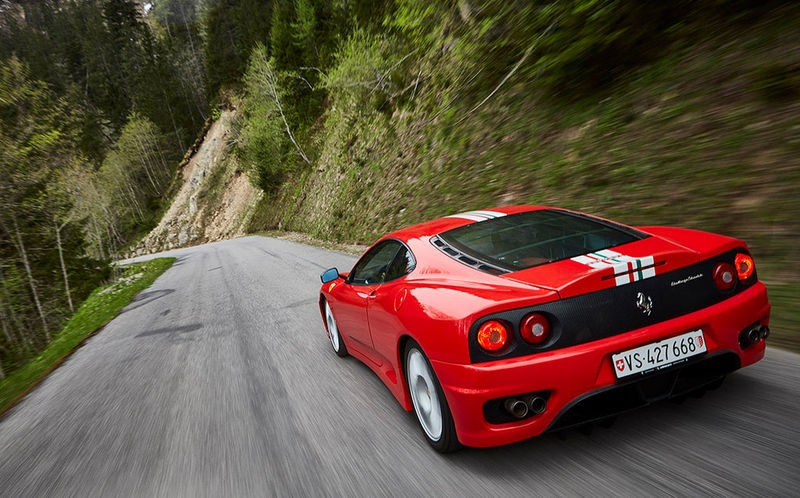
To be clear, the 360 Challenge Stradale wasn’t a homologation special, a production model like the 288 GTO built specifically to form the basis of a racing car. Instead, it was designed to bring the feeling of a racing car to the street – or stradale, in Italian.
This car looks notably more purposeful than a regular 360, so how did Ferrari achieve that? While the aluminium body panels remain untouched, variant-specific bumpers and side sills, plus 15 mm shorter springs, were fitted to create a new hunkered-down stance. The result is a near-perfect blend of road and race car, down to the Brembo carbon-ceramic brakes behind the 19-inch Challenge-style wheels.

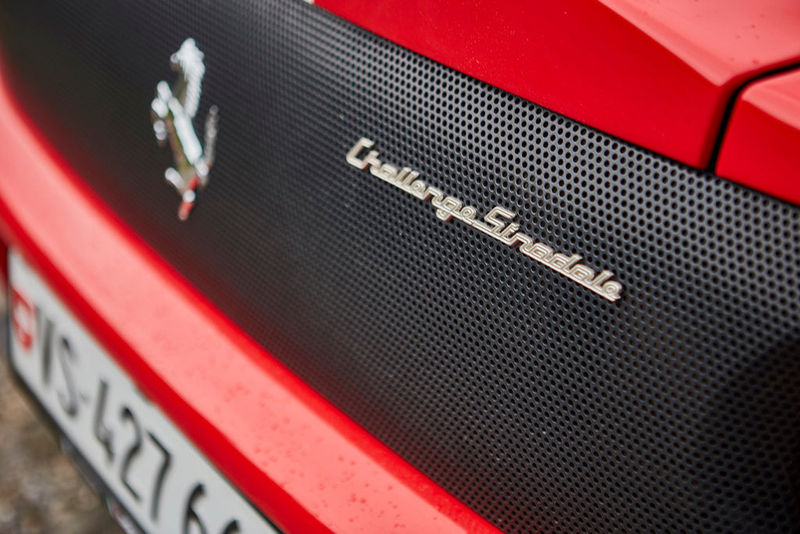
As I walk to the rear of the 360 Challenge Stradale, my eye is drawn to the Perspex rear screen, which is supported by a pair of carbon-fibre crossbars. The minimalist engine bay seems desolate compared with the extensively wired, ancillary-packed compartments found in contemporary machinery.
A road car with a race car feel
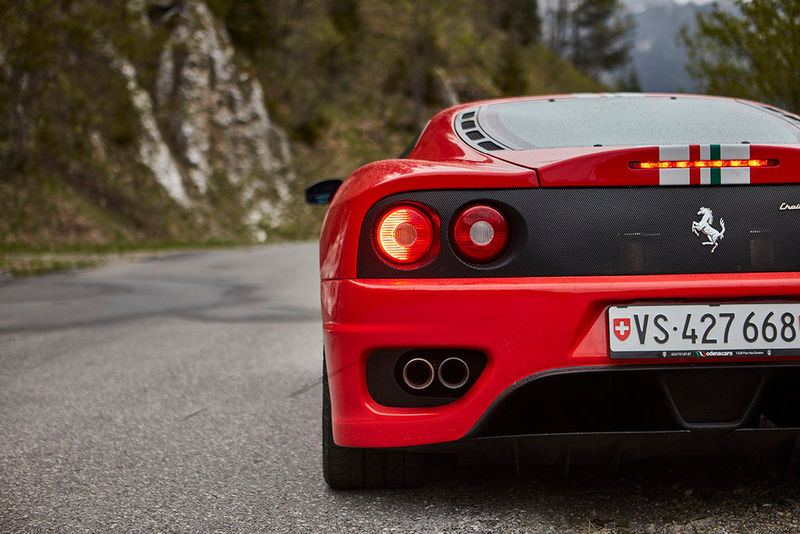
The Challenge Stradale’s exhaust outlet layout is the same as the Modena’s, but the former has a much more elaborate rear diffuser. When I bend down to examine it, I can also see the car’s flat underfloor; the engineers evidently had high-speed stability in mind!
All the aero upgrades increase downforce to nearly 270 kg at top speed, some 90 kg more than the Modena. The Challenge Stradale’s model-specific Pirelli P Zero Corsa tyres – 225/35 up front, 285/35 at the rear – will further beef up the Ferrari‘s roadholding.
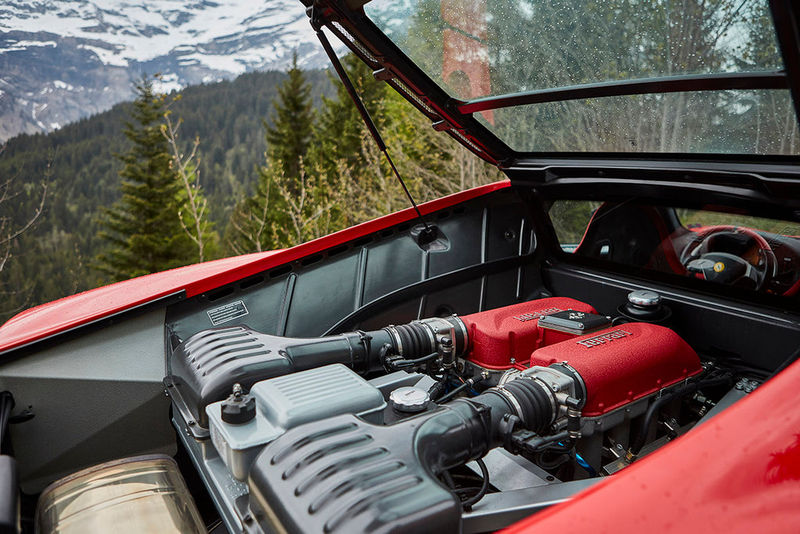
Power is a major part of the track game, of course, so Ferrari gently upped the compact 3.6-litre V8’s compression ratio, fitted a larger airflow meter, ported this and polished that, installed a less-restrictive exhaust, and so on. The result was a power hike of just under 20 kW (for a peak output of 312 kW), also developed at 8 500 rpm (as on the Modena), and a 4.1-sec zero to 100 kph sprint time (0.4 sec quicker).
The improvement in acceleration was further aided by a faster-shifting F1 transmission (the only gearbox available) and an intensive weight-saving programme. In addition to major reductions (by eliminating sound-deadening, for example), Ferrari’s engineers saved grams in numerous small areas, such as making the suspension springs and wheel bolts from titanium and the airboxes from carbon fibre.
In the end, the 360 Challenge Stradale tips the scales at 1 280 kg versus the 360 Modena’s 1 390 kg.
Weight-saving measures aren’t subtle
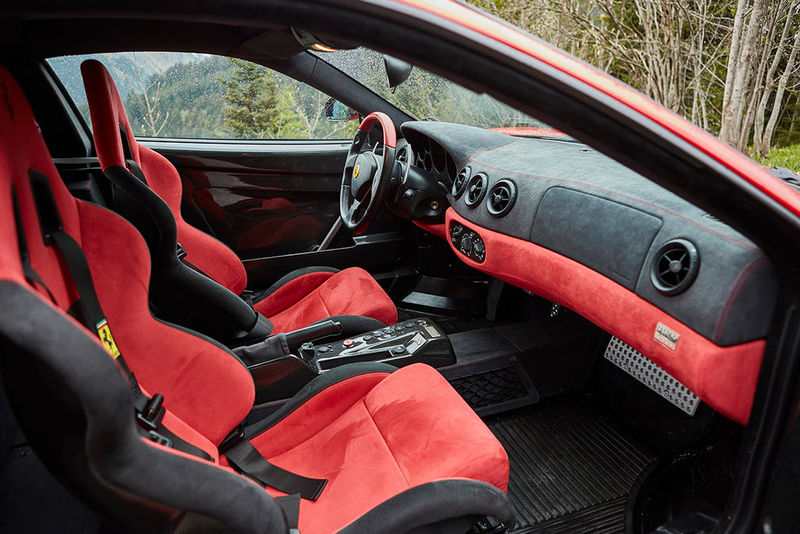
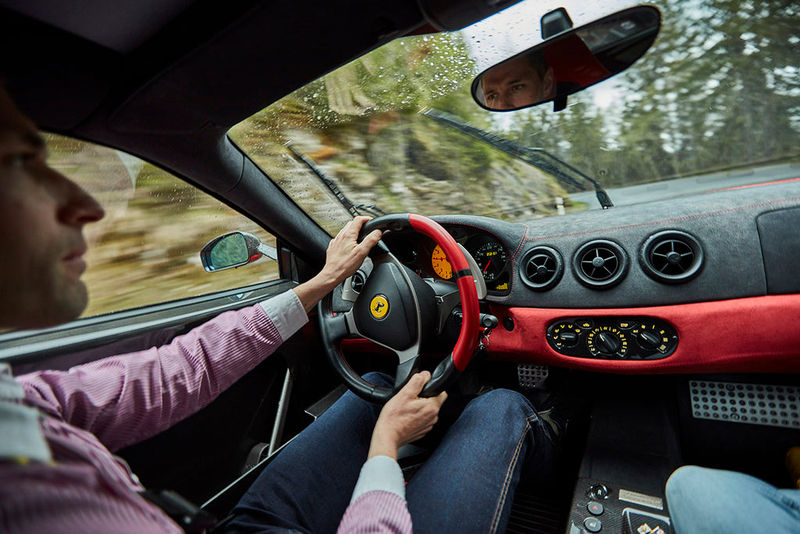
The weight savings are most noticeable in the cabin. If you think the more recent F12tdf or 488 Pista are stripped out, you haven’t spent much time in a 360 Challenge Stradale! There’s no infotainment system – not even a radio – and no screens of any sort. As a matter of fact, there is very little at all on the 2-tone Alcantara dash (beyond the analogue gauges and HVAC controls). A simple glance at the carbon-fibre transmission tunnel further illustrates the simplicity of the cabin; there are no luxuries – only function.
Specifications
- Model: 2003-2005 Ferrari 360 Challenge Stradale
- Engine: 3.6-litre, V8, petrol
- Power: 312 kW at 8 500 rpm
- Torque: 373 N.m at 4 750 rpm
- Transmission: 6-speed semi-auto
- Weight: 1 280 kg
- 0-100 kph: 4.10 sec (claimed)
- Top speed: 300 kph (claimed)
The minimalism continues under my feet. The welding points in the aluminium frame are exposed, and simple rubber mats cover the carbon-fibre floorpan; as in that iconic ’80s supercar – the F40 – you can see where the floor has been glued to the chassis. Carbon fibre has also been used for the supportive sports seats – and door panels. The doors themselves are as light to open (and close) as you’d expect.
What is the Ferrari 360 Challenge Stradale like to drive?
As I click the 4-point harness into place, I’m faced with a button-free 3-spoke steering wheel and a set of easy-to-read dials in the instrument cluster. The rev counter takes centre stage (the speedometer is to the right, with the oil and water temperature dials to the left, of the tachometer). Better still: the 7 000 rpm mark on the middle dial perfectly lines up with the black leather ring at the top of the steering wheel.
The VIN plate sits right atop the steering column, and, oddly, the right shift paddle is longer than the left one.
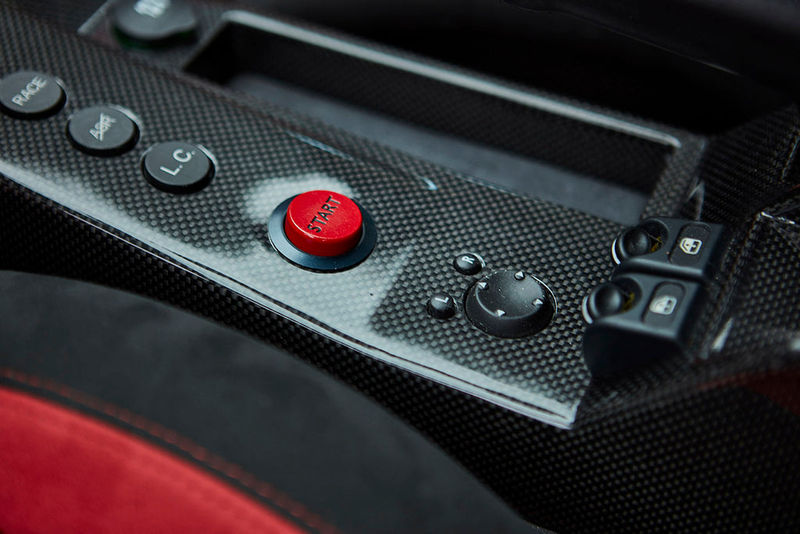
I turn the key and press the cartoonish starter button on the transmission tunnel. The engine whirs, then erupts with a harsh, urgent bark. Those standing near the rear of the car are treated to the full, unfiltered soundtrack at startup, but from inside, the V8 doesn’t sound particularly appealing when it’s idling.
Lower the window and blip the throttle, though, and the hard-edged, metallic voice of this naturally aspirated V8 pipes up unequivocally. It sounds rawer and less tuned than the intense, “engineered” voices of Ferrari’s more modern machinery, which is in keeping with the functional nature of the car.
Just outside the town of Les Diablerets in Switzerland, a tight mountain pass runs south up the mountain towards the next valley. It is, in my opinion, the perfect piece of tarmac for the 360 Challenge Stradale, although the bitumen surface has been repaired in a few places, probably owing to the harsh weather conditions that these roads are exposed to every season.
I pull the right paddle to select 1st gear and pull away. Shifting up to 2nd, it’s clear that, by modern standards, the 6-speed single-clutch F1 transmission takes its time. It’s hard to believe 150 milliseconds was once considered lightning-fast, and that’s the fastest shift possible in Race mode! I can discern how the engine’s power delivery is interrupted before each gear change, after which the torque “reappears”.
For the best (smoothest) results, lift off the throttle ever so slightly before changing gear. Get it wrong, and the transmission will make its displeasure clear. That truly is the only jarring aspect of the Challenge Stradale experience, however, and it’s an easy one to forgive, as the rest of the car is fantastic.
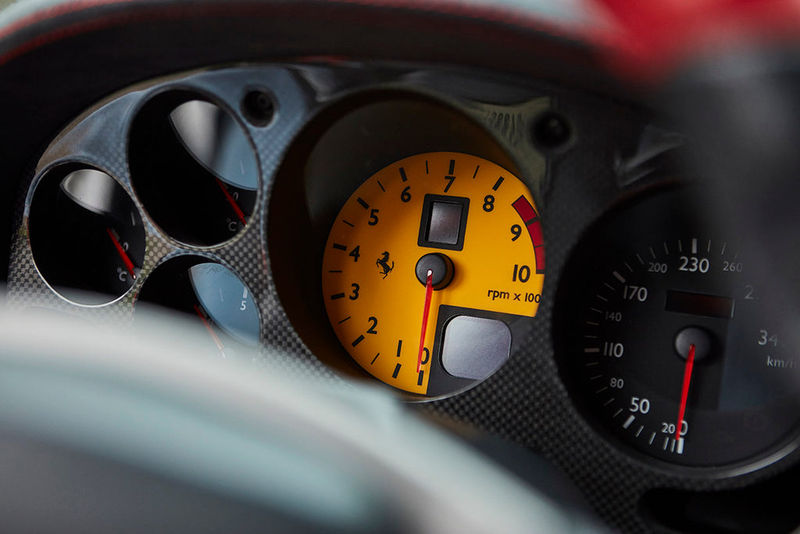
The engine, for instance, will happily zip the Ferrari along at 3 500 to 4 000 rpm, but zings to life beyond 6 000 rpm. Once on the proverbial cam, the V8 seems to have almost zero inertia around the 8 500 rpm redline. The rev counter needle swings so quickly and effortlessly that I find myself rushing upshifts.
The brakes, borrowed from the Enzo supercar, no less, are nothing short of vigorous. They react the moment I press the firm pedal and, despite a bit of pad noise, make easy work of whatever task is at hand. I’m further struck by how little the nose of the 360 Challenge Stradale dips under braking.
Turn-in is impressively quick and direct (thanks to the stiffer springs, a larger rear anti-roll bar, and a rapid steering rack), and there’s sufficient feedback through the wheel. The sports seats and harness comfortably hold me in place, and the clattering of fine road debris against the car’s underbody and the insides of the wheel wells only adds to the exciting, back-to-basics sportscar experience.
The original owner of this car chose not to specify the optional audio system, which, aside from adding some weight, is contrary to the fundamental idea of the 360 Challenge Stradale, anyway.
He did specify normal glass side windows instead of Perspex panes with small sliding openers, but the improvement in usability and visibility means we won’t hold that against him! Nor will the current owner of this Ferrari, who graciously handed me the keys after owning the car for only about 2 weeks!
That 4-point harness keeps you pinned
During that fortnight, the new owner took his 360 Challenge Stradale for a proper drive: a 2 500 km road trip through southern Europe, a route that included some of the best driving roads in the world.
He explains: “Although the 4-point harness positively keeps you in place through the mountain passes, it presents a challenge when you need to lean out the window to pay your fare at toll booths. Then there’s the large turning circle, which isn’t ideal, although it’s less of an issue than you might think.
“I like the little details about the car,” he concludes. “These include the Alcantara on the dashboard, the big (overly simple?) red starter button, and the overall rawness of the car. I also like the fact that the CS is not a conventional automatic. It will shift down automatically, but you need to actuate upshifts.”
Summary
In an era when 500 and 600 kW Ferraris are nothing out of the ordinary, 312 kW might not fill enthusiasts with much excitement. Fortunately, the Ferrari 360 Challenge Stradale isn’t focused solely on speed; it’s more about the overall driving experience and the way the car communicates with its pilot. It is far more involving to drive than, say, the newer and faster 488 Pista. Add to that the 360 Challenge Stradale’s position as the 1st of this rare breed, and it’s no surprise this Ferrari has become an instant classic.
Find a classic Ferrari listed for sale on Cars.co.za
Related content:
Ferrari F355 Challenge: Classic Drive
Ferrari 458 Speciale vs 488 Pista: Classic Comparison
Ferrari F12tdf vs 365 GTB/4 Daytona: Classic Comparison